
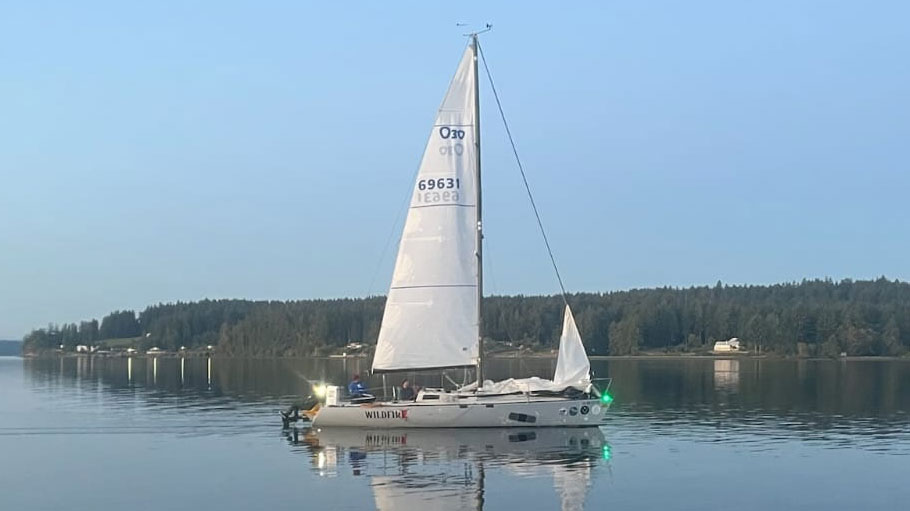
Team members: Tristan Zeman, Benjamin Freeman, Vladimir Zeman, Sebastien Zeman, Stewart Williams
Hometown: Westport, CT, USA
Race vessel: Olson 30
LOA: 30′
Human propulsion: Pedal (Prop)
My name is Wildfire. I’m an Olson 30, I’ve finished Race to Alaska twice, survived WA360 once, and I would like the record to reflect that previous crews left me smelling like French onion soup and wet neoprene for weeks.
Now I’ve been handed over to Team Pas Si Vite, an East Coast collection of offshore sailors, ski patrollers, avalanche-trained mountaineers, and highly organized endurance enthusiasts who appear determined to “approach the race deliberately.”
Adorable.
From what I’ve gathered, they’ve spent a bunch of time talking about all the details—who will hold my tiller all night, what they’re going to bolt to my transom for when the windy stuff doesn’t blow into my cloth-parts. They’re going to do some formal offshore safety training. They use phrases like “decision framework” in casual conversation. One of them is apparently worried about under-seasoned food, which suggests a basic misunderstanding about how taste buds work after eight days of sleep deprivation.
To be fair, these people seem to know how to turn around when conditions deteriorate. Several team members have abandoned summit attempts, waited out weather systems, assisted in mountain rescues, and generally behaved like people interested in surviving. That already places them above average by Race to Alaska standards, or maybe at least the past yahoos who drove me. They appear to understand that survival depends less on boldness than on recognizing the exact moment boldness begins to curdle into stupidity.
The Race to Alaska Podcast
Episode 17: Team Oaracle, Team Hell ‘N’ Ready, Team Pas Si Vite
→ Listen on Spotify
→ Listen on YouTube
→ Listen on Apple Podcasts
First things first, why Race to Alaska?
Because it’s one of the last races that still feels like an expedition.
No engines. No outside support. No easy resets. Just current, weather, preparation, and the judgment of the crew. R2AK strips sailing back to fundamentals and forces teams to rely on seamanship, strategy, and each other.
What draws us north isn’t only the distance or the destination. It’s also a test of decision making. Choosing when to push and when to wait. Managing fatigue. Adapting when the plan unravels. The race rewards humility, discipline, and teams that can stay composed under pressure.
What’s the one piece of advice you’re absolutely going to ignore?
“Just push through it.”
There’s a difference between useful discomfort and clouded judgment. We aim to remember the difference. If fatigue, conditions, or systems are degrading performance, we will reset before small problems become big ones.
Luck/Skill Ratio
49:51
Duct Tape Fixes (Linear Feet)
68.5