
For a race that spent months threatening to destroy boats and people, Race to Alaska 2026 has so far chosen a different method to its madness. The forecast for the full race continues to play coy, draping isobars lazily across the chart as if nothing dramatic could possibly happen.
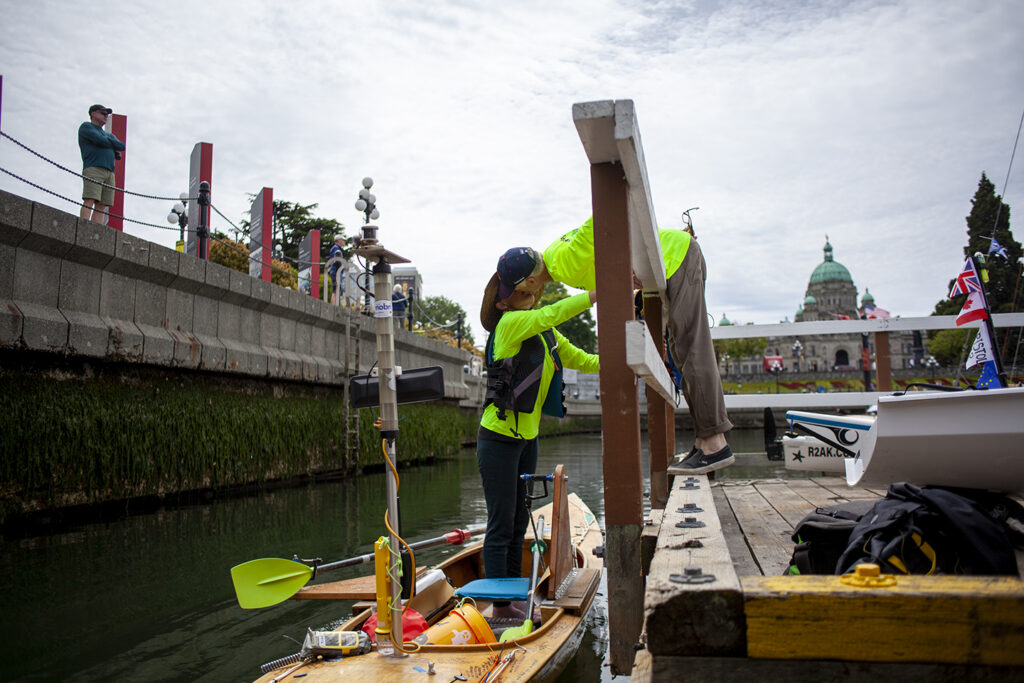
At HIGH NOON tomorrow, 210 humans comprising 66 race teams will gather in front of Victoria’s Fairmont Empress Hotel awaiting the start. We make them run down the stone stairs, positively elbow one another for access to the gangway, and careen down the docks to hop in their many and varied craft—it’s equal parts adventure race and multi-vehicle traffic pileup. Teams aren’t allowed to sail until they have cleared Victoria Harbour, meaning the every boat will be furiously pedaled, rowed, cranked, sculled, and otherwise manhandled through a confined space that also happens to contain ferries, and water taxis. Oh, and also the Inner Harbour floatplane terminal—try landing an aircraft in the middle of that hot mess.
Once teams escape the harbour and can finally hoist sails, they may discover that them sails won’t do much. So hopefully teams are spending today lubing up those pedal drives and making sure they’ve got a bag of spare parts.
But there are growing signs that the weather is just setting the hook—the fight’ll come later. West of Vancouver Island, a substantial high pressure system is beginning to organize and appears increasingly interested in parking itself in exactly the wrong place. Should it settle in as forecast, northerly winds will begin to funnel down the Inside Passage, turning the route north into a blustery conveyor belt running the wrong direction. Teams congratulating themselves today on surviving the heat of the weekend will find themselves slogging into twenty, thirty, or possibly one million knots of headwind.
As always, speculation on the docks is rampant, unreliable, and entirely free for the taking. If betting were legal, chips would be stacked on Team Northbound Nutters and their Corsair F32-SR. On paper, it’s exactly the sort of machine that makes naval architects smile and other competitors nervous—it’s big, it’s yellow, and it looks fast. Then again, Race to Alaska has never been interested in what works on paper. Big multihulls have historically performed very well right up until they crush their ultralight shells into the invisible horizontal forest currently floating through the waterways of coastal British Columbia.
And there is plenty of forest. Huge tidal exchanges over the last several days have been flushing logs, root balls, and assorted timber bits off beaches and hillsides and into the race course, creating conditions that recall R2AK 2022, when floating debris systematically disassembled a not-zero number of teams within the first twenty-four hours of the race.
For now, Victoria remains in that strange, suspended calm before the bill arrives. It’s nice out. Racers are provisioning, icing sore legs, and rebuilding half-spent pedal drives. They’re dutifully replacing chafed lines, charging electronics, and updating weather apps every twelve minutes in hopes that one of them will finally lie to them in a way they like. Along the docks, friends, family, and spectators are making predictions with complete confidence and no supporting evidence whatsoever.
By this time tomorrow, Victoria Harbour will be empty of racers, trackers screens will be furiously refreshing, and sixty-six teams will be somewhere out in the salt, finding out exactly which parts of their preparation were actually just optimism.
Header photo by Lynnette Oostmeyer | Video by Garret Weintrob