
Today’s Daily Update is available exclusively to paying subscribers.
We’d like to thank all of our paying subscribers for making this coverage possible. Unfortunately, there are zero of you. Which means today’s update will necessarily be brief, skeletal, and missing its soul.
Here we go:
- A boat did a thing.
- Another boat also did a thing.
- Several people got wet.
- At least three pedal drives didn’t do what they were supposed to.
- Somebody probably dropped out for a good reason.
Not so satisfying.
Maybe you’ve noticed that since the race started, you’ve gotten something that’s generally impossible on the internet in 2026. You click the link. The story opens. Nobody forces you to give up your email address or your mother’s maiden name. Nobody gives you three free articles before demanding a credit card. Nobody blurs the photos until you become a Platinum Admiral Elite Ultra Diamond Captain. You just get the update. Every day. We like it that way.
But hold up: none of this is free to produce. Writers write. Videographers video. Photographers chase boats into the salt spray. Volunteers give up their sleep and sanity. Cameras break. Satellite internet receivers have to be fashioned out of driftwood and desperation. There are ferries, flights, damp sleeping bags, lukewarm coffee, spreadsheets, logistics, livestreams, and all the time it takes to respond to the people complaining that they can’t hear the livestreams.
Which brings us to something a huge number of Race to Alaska fans don’t know: Race to Alaska isn’t its own nonprofit. It’s definitely not a Larry Ellison side-project.
It’s part of Northwest Maritime.
NWM’s mission is to create transformative maritime experiences. That’s not the official language, but in practice it means getting people on the water in ways that change them. Sometimes that’s a kid stepping onto a sailboat for the first time. Sometimes it’s preserving maritime traditions, teaching boatbuilding, hosting festivals, or building community around the water. And sometimes it’s watching otherwise sensible adults point a boat toward Alaska without an engine and discover things about themselves they probably would have preferred to learn another way.
Race to Alaska is simply the pointiest, sharpest, least comfortable expression of that same idea.
Everything you’ve been enjoying – the Daily Updates, the tracker, the photography, the videos, the livestreams, and the intrepid and sleep-deprived crew of staff and volunteers chasing this race up the Inside Passage – exists because Northwest Maritime believes these experiences are worth creating and these stories are worth telling. We don’t want to put any of it behind a paywall. We’d much rather ask the people who’ve enjoyed it to help keep it free for the next person who stumbles across this wonderfully ridiculous race.
To make that decision easier, we’ve developed a series of highly scientific suggested donation levels.
$25 — You laughed at least once.
$100 — You’ve developed strong opinions about someone else’s route while remaining comfortably on land.
$2,418 — One penny for every pedal stroke. We used advanced biomechanics, race telemetry, and a volunteer named Dave who stared thoughtfully into the middle distance before saying, “Couple hundred thousand, easy.”
Any other amount: also excellent. Dave supports this option too.
If these updates have become part of your June, we’d be grateful if you’d support Race to Alaska with a donation. You’re not paying for today’s story. You’re helping to make sure there are stories to tell next time.
Now, here’s where this whole subscription experiment falls apart.
Our internal confidence was high regarding ending the update right there and leaving you wondering what actually happened on the water. It was going to be a powerful, sweeping statement about the economics of modern media and nonprofit-ry in the age of Big Capitalism. It lasted about thirty seconds, because someone inevitably walked into the room, looked over our shoulder, and said, “Yeah, but wait until they hear what’s happening up there.”
There’s still two full weeks left in Race to Alaska, which feels like an absurd amount of time until you look at the weather. The front we mentioned yesterday is increasingly determined to settle into the northern race course as a stiff northerly, and if it does, the teams still making their way north under human power could be facing a very long, very slow grind. That, or a lot of espresso drinks in Port Hardy.
In 2024, something happened that had never happened before in Race to Alaska: not a single all-human-powered team reached Ketchikan. The Blister Prize wasn’t awarded because there was nobody to award it to. This year we introduced the Hecate Solo Star Award for the first female solo human-powered finisher, and while we’d very much like to hand it to somebody, the forecast is beginning to ask some uncomfortable questions.
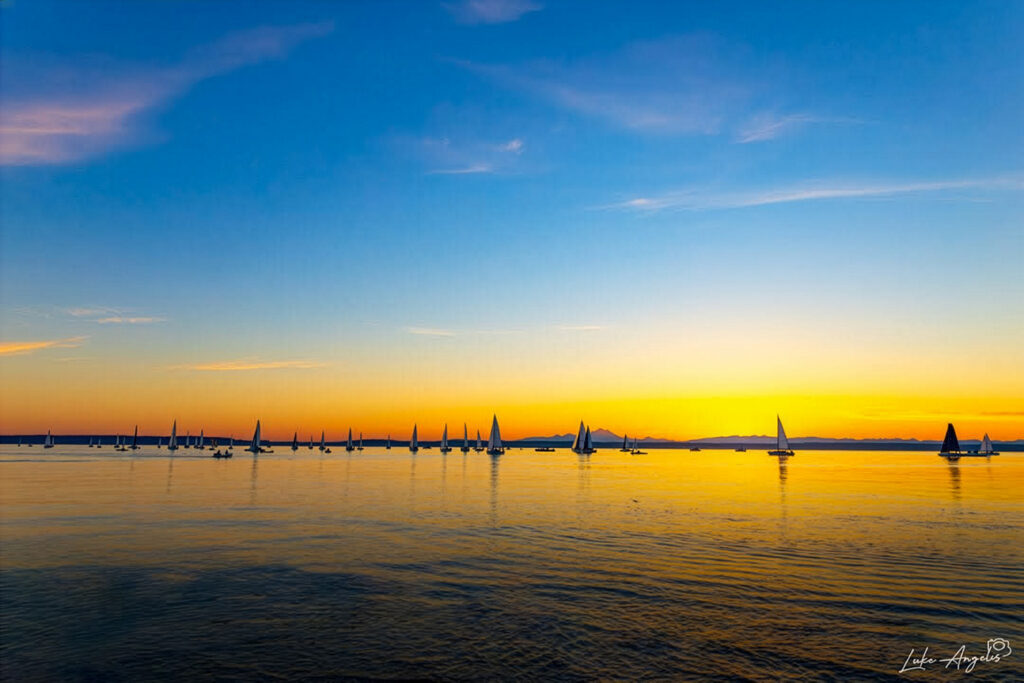
Header photo by Luke Angelis